
There is something rather extraordinary about a solar eclipse. In the middle of the day, the light begins to fade, the temperature can change, shadows behave differently and, for a short period, the world starts to look and feel more like evening.
We know exactly what is happening, but our dogs simply experience a very unusual change in their environment. So could a solar eclipse actually affect your dog’s behaviour?
The honest answer is that we do not know exactly how individual dogs will respond, and there has been surprisingly little research specifically looking at pet dogs during eclipses. However, research involving other animals has shown that eclipses can produce noticeable behavioural changes.
During the 2017 total solar eclipse in the USA, researchers at Riverbanks Zoo observed 17 different vertebrate species and found that many displayed behaviours associated with the change from daylight to darkness. Some animals became more active, some appeared anxious, while others began behaviours they would normally associate with night-time.
There are also historical observations involving dogs. Reports from previous eclipses have described dogs appearing frightened, whimpering or attempting to hide. However, researchers have also acknowledged that it can be difficult to determine whether dogs are responding directly to the eclipse or to changes in the behaviour of the humans around them.
And that is an important point.
Your dog may notice that YOU are behaving differently
Imagine your dog is peacefully asleep on the sofa when suddenly you start behaving unusually. You keep looking towards the sky, perhaps people are gathering outside, there is more excitement than normal, the light is changing and your usual routine has been interrupted.
Your dog doesn’t know that you are watching an astronomical event. They simply know that something is different. Dogs are incredibly good at noticing changes in our behaviour, body language and routines. So if your dog seems unsettled during an eclipse, it would be too simplistic to assume that they are frightened by the eclipse itself.
They could be responding to the combination of unusual environmental changes, changes in human behaviour and the disruption to their normal routine.
What might your dog do during an eclipse?
There is no single “eclipse reaction” that you should expect. Some dogs may barely notice anything at all. They may carry on sleeping, playing, eating and behaving exactly as normal.
Other dogs may become quieter as the light changes, perhaps settling down as though evening has suddenly arrived early. This would make sense given that many animals use changes in daylight as cues for their daily activity and sleep patterns.
A more sensitive dog might become restless or unsettled. You could see pacing, panting, whining, barking, hiding or increased clinginess. Some dogs may repeatedly seek their owner’s attention or have difficulty settling.
However, these behaviours don’t necessarily mean your dog is frightened. Context is important. For example, a dog who normally sleeps during the afternoon may simply settle down when the light fades. A dog who is already anxious about unusual noises, visitors or changes to routine may find the whole experience more difficult. This is why looking at the individual dog is much more useful than assuming that all dogs will react in the same way.
How to help your dog during an eclipse
Fortunately, there is no need to do anything elaborate. In most cases, the best approach is to keep things as predictable and normal as possible.
Keep their normal routine
Feed your dog at their usual time, provide their normal toilet opportunities and maintain their usual routine as far as possible.
Predictability can be particularly helpful for dogs that are already prone to anxiety or who struggle with changes to their environment.
Give them somewhere safe and comfortable
Make sure your dog has access to their usual bed, crate or quiet area. If they choose to retreat somewhere, allow them to do so. A dog that is feeling worried may find it reassuring to have somewhere they can escape to without being disturbed. Don’t force your dog out of their hiding place because you think they need comforting. Giving them control over whether they approach you or remain in their safe space can be much more helpful.
Watch your own behaviour
This is one of the easiest things to overlook.
If you’re excited about the eclipse, you may be behaving very differently from normal. You might be moving around the house, repeatedly looking outside, inviting people over or talking excitedly. Your dog will notice. There is absolutely nothing wrong with being excited about an eclipse, but if your dog is sensitive, try to avoid making the event feel even more dramatic for them.
Give them something familiar to do
A stuffed food toy, chew, snuffle activity or simple training game can provide something predictable and enjoyable while the environment is changing. If your dog is too worried to eat, however, don’t keep pushing food towards them. A normally food-motivated dog refusing a favourite treat can be a useful indication that they are feeling uncomfortable.
Be particularly careful with doors and gates
This is especially important if you have a nervous or easily startled dog. An unusual environment can sometimes result in behaviour that is very different from your dog’s normal behaviour. A dog that would never normally attempt to escape may try to get away if they become frightened.
If you’re attending an eclipse event, there may also be crowds, unfamiliar people, traffic and unusual noises. Those factors could potentially be more significant for your dog than the eclipse itself.
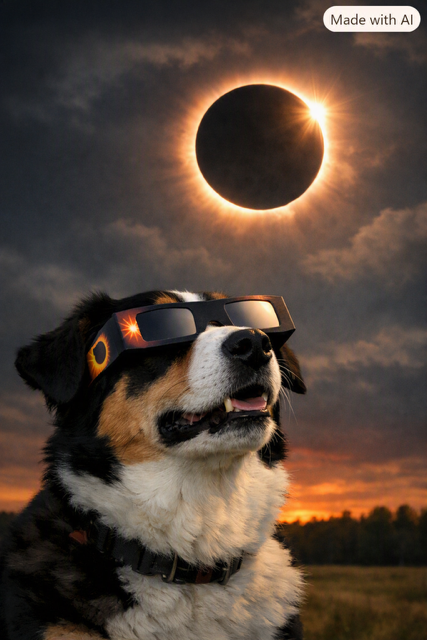
Don’t make your dog watch the eclipse (despite the photo!)
You may see photographs of dogs wearing eclipse glasses or looking towards the sky. There is no reason to encourage your dog to stare at the sun. Dogs don’t need to participate in your eclipse viewing experience. If you’re going outside to watch it, your dog can simply remain somewhere safe and comfortable.
Could an eclipse cause separation problems?
If your dog already struggles when you leave them alone, an unusual event such as an eclipse could potentially make things more difficult, particularly if their normal routine is disrupted.
For example, if you suddenly change your usual schedule, leave them for longer than normal or take them somewhere unfamiliar to watch the eclipse, you could inadvertently add several changes at once.
If your dog has existing separation-related problems, I’d recommend keeping their routine as consistent as possible rather than using the eclipse as an opportunity to test how they cope.
The same principle applies to any unusual event. When a dog already finds something difficult, adding several other changes at the same time can make it much harder for them to cope.
What if my dog doesn’t react at all?
That’s completely fine!
Some dogs may sleep straight through an eclipse. Others may briefly look around when the light changes before returning to whatever they were doing.
There is no reason to expect your dog to have a dramatic reaction simply because other animals have been observed behaving differently during eclipses. In fact, one of the most useful things you can do is observe rather than anticipate. Instead of worrying that your dog might become frightened, watch what they actually do.
The bigger lesson for dog owners
I find eclipses fascinating from a canine behaviour perspective because they are a useful reminder that behaviour doesn’t happen in isolation. We sometimes look at a dog’s behaviour and immediately ask, “What’s wrong with my dog?” A better question can be, “What’s changed?”
Changes in light, temperature, sounds, smells, routine, social interactions and our own behaviour can all influence what a dog does. That doesn’t mean every unusual behaviour has a complicated explanation. Sometimes a dog is simply being a dog. But learning to look at the bigger picture can help us understand our dogs much more accurately.
So when the next eclipse comes around, don’t worry about whether your dog should react.
Simply observe.
Does your dog settle down? Become more alert? Follow you around? Ignore it completely? Look for somewhere quiet?
Their behaviour is giving you information. And understanding that information is one of the most important skills any dog owner can develop.
Solar Eclipse and Dogs: Frequently Asked Questions
Can dogs sense a solar eclipse?
There is evidence that animals can respond to the environmental changes associated with an eclipse, particularly the sudden reduction in daylight. However, there is currently no good evidence that dogs understand what an eclipse is or can predict one in the same way that humans can.
Can a solar eclipse make dogs anxious?
It is possible that some dogs may become unsettled during an eclipse, particularly dogs that are already sensitive to changes in their environment. However, there is no evidence that all dogs become anxious during an eclipse.
If your dog does become unsettled, look at the whole situation rather than assuming the eclipse itself is the cause.
Why do some animals behave differently during an eclipse?
Animals use environmental cues such as daylight and darkness to regulate many aspects of their behaviour. A sudden change from daylight towards darkness can therefore alter activity and rest patterns.
Research conducted during the 2017 total solar eclipse found changes in behaviour across a number of animal species, with some displaying behaviours normally associated with night-time.
Should I keep my dog indoors during an eclipse?
If your dog is comfortable at home, keeping them indoors can be a simple way of maintaining a familiar environment, particularly during the period of maximum darkness.
However, there is no general requirement for dogs to be kept indoors simply because an eclipse is taking place. The most important consideration is your individual dog’s behaviour and the environment around them.
Should dogs wear eclipse glasses?
There is no need to make your dog look at the eclipse or to encourage them to stare towards the sun. The safest approach is simply not to direct your dog’s attention towards the sun.
Can dogs look at the sun during an eclipse?
Dogs should not be encouraged to look directly at the sun. If you are watching an eclipse yourself, don’t deliberately position your dog so they are looking upwards towards it.
What should I do if my dog becomes frightened?
Give your dog access to somewhere quiet and familiar where they can retreat. Keep your own behaviour calm and predictable, avoid forcing interaction and allow your dog to decide whether they want to approach you.
If your dog shows severe or prolonged signs of anxiety, or their behaviour remains unusual after the eclipse has passed, speak to your vet or an appropriately qualified canine behaviour professional.
Will every dog react to an eclipse?
Absolutely not.
Some dogs may show a noticeable change in behaviour, while others may completely ignore the event. Dogs differ enormously in their sensitivity, previous experiences, temperament and ability to cope with environmental changes.
There is no “normal” eclipse reaction that every dog should display.
Could my dog’s behaviour change after the eclipse?
It is possible that some dogs may take a little time to settle back into their normal routine if the event has been particularly stimulating or if their routine has been disrupted.
For most dogs, however, any behavioural change should be temporary.
If you notice a significant or persistent change in behaviour, don’t automatically blame the eclipse. Behavioural changes can have many causes, including pain, illness, stress or changes within the household, so persistent changes should be investigated appropriately.
One final thought
An eclipse is an extraordinary event for us because we understand what we are seeing.
For our dogs, it is simply an unusual change in their world.
And perhaps that is the most useful way to think about it.
Rather than worrying about whether your dog will react, give them what they need to cope with any change: a predictable routine, somewhere safe to retreat, the freedom to make choices and an owner who is paying attention.
Because when it comes to understanding dogs, sometimes the most valuable thing we can do is simply watch, listen and ask ourselves:
“What is my dog telling me?”