
We spend a lot of time teaching our dogs how to behave.
We teach them to sit, stay, come back when called, walk nicely on the lead and not jump up at visitors. We spend hours trying to understand why they bark at other dogs, pull towards something interesting or suddenly refuse to move.
But how often do we stop and ask a much simpler question?
What is my dog actually trying to tell me?
There has been a lot of discussion recently about responsible dog ownership, education and improving the relationship between dogs and people. The latest Responsible Dog Ownership review commissioned by Defra puts considerable emphasis on education, training and helping people understand how to live safely alongside dogs.
And I think there is another part of that conversation that deserves more attention.
Learning to observe our dogs.
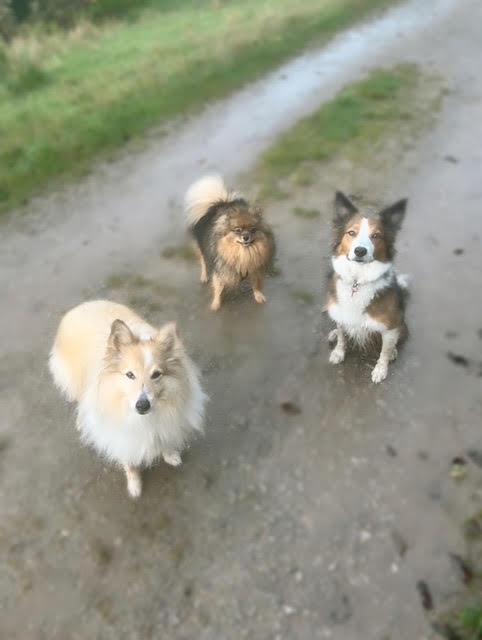
I have three very different dogs living with me, here they are 👆
I have a 15 year old Sheltie, a 10 year old Collie and a 4 year old Pomeranian.
They are very different dogs, not only because of their breeds but because they are at completely different stages of life.
My 15-year-old Sheltie doesn’t necessarily experience the world in the same way he did when he was younger. His physical abilities, energy levels and tolerance may have changed over the years.
My 10-year-old Collie has her own preferences, habits and ways of communicating. And then there is my 4-year-old Pomeranian, who brings a completely different set of behaviours and reactions to the household.
Living with three dogs has given me an even greater appreciation of how important it is not to look at behaviour in isolation.
A dog isn’t simply being “good” or “bad”.
Their behaviour is information.
Watch the dog, not just the behaviour
Imagine your dog suddenly stops walking. You could interpret it as stubbornness. But what else could be happening?
Perhaps they’ve noticed something you haven’t. Perhaps they’re unsure about something ahead. Perhaps they’re tired. Perhaps the ground is uncomfortable. Perhaps they’re simply interested in a smell and want to investigate.
Or imagine your dog starts yawning while you’re interacting with them. That doesn’t automatically mean they’re tired. Yawning can occur in a variety of situations, so rather than immediately deciding what it means, look at everything else happening at the same time.
What is their body doing?
Where are their ears?
What is their tail doing?
Are they moving towards you or away from you?
Are they loose and relaxed, or tense?
Are they choosing to engage, or trying to create some distance?
The more pieces of the puzzle you look at, the better you become at understanding the individual dog in front of you.
Dogs don’t come with subtitles
One of the biggest mistakes we can make is assuming that every dog communicates in exactly the same way.
We might expect a frightened dog to hide. But some dogs become very noisy.
We might expect a dog who is uncomfortable to move away. But some dogs can’t or don’t, particularly if they are on a lead or trapped in a particular situation. We might see barking, lunging or growling and focus entirely on stopping the behaviour.
But if we don’t ask why the dog is doing it, we can miss the message underneath it. This is particularly important when we are dealing with behaviour that humans find difficult. The behaviour we see is often the end result of a much longer sequence of events.
Try watching your dog without trying to change anything
Next time you’re out walking, spend five minutes simply observing your dog.
Don’t train them.
Don’t ask for behaviours.
Don’t correct them.
Just watch.
Notice what they choose to investigate. What makes them speed up? What makes them slow down? Which dogs do they notice? Which people do they notice? Where do they choose to walk? When do they look at you?
You might be surprised by how much information you’ve been missing. And you don’t have to wait until there is a problem to start doing this. Observation is one of the most useful skills any dog owner can develop.
The 2026 Dogs Trust National Dog Survey found that 90% of owners regard their dog as part of the family, with 96% saying having a dog is good for their mental health.
If our dogs are such an important part of our lives, it makes sense that we should become better at understanding them. Not just teaching them what we want. But listening to what they are telling us too.
Because sometimes the most useful thing you can do with your dog isn’t ask them to do something.
It’s simply watch.